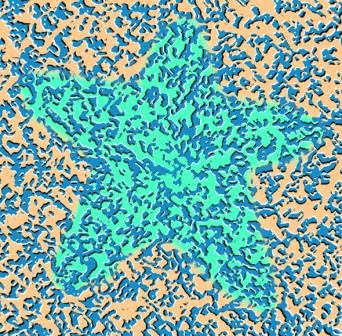
Here the peripheral drift illusion is used with an overlaying pattern of irregular random shapes to convey the sense of motion of a larger shape. The pattern is generated with a "flow direction" determined by the offset white and black versions of the pattern behind it.
Showing posts with label Motion. Show all posts
Floating Star Optical Illusion
Einstein Time Travel Optical Illusion
Time is a part of the measuring system used to sequence events, to compare the durations of events and the intervals between them, and to quantify rates of change such as the motions of objects.
Flashing Squares Optical Illusion
During the Optical Art Movement of the 1960s, artists would create all sort of puzzling effects with color. For instance, this "flashing squares" drawing seems to wobble and flash when you concentrate on one particular area of the image. How many squares can you see in this diagram? Can you feel the "motion" of the image?
Advanced Rollers Optical Illusion
In the beginning we had rollers and snakes, optical illusions born accidentally,
probably as a by-product to some sort of color experiments. Most of them were
invented by a Japanese professor, Akiyoshi Kitaoka. Since then, optical illusion
societies have grown. Just look at our website, for example. Many enthusiasts
began experimenting with existing material. While during the process, some
of them developed their own style, adding great value to this particular topic.
Observe the patterns below, and you may find them somehow relaxing.
Even though posing as static images, they manage to give you that motion
feeling, making our head hurt and eyes spin.
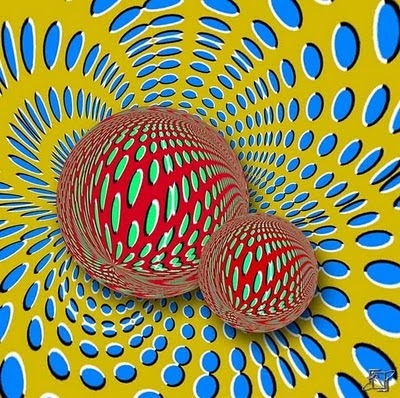
Blue Car motion illusion
Floating Motion optical illusion
Floating Motion optical illusion, you do not have to do anything but just exploratory eye movements over the image the centre square decouple. when you stare at the background it seems to move while central square remains in same place and it seems to float on top.
Impossible Motion magnet like slopes illusion
This optical illusion has been created in three dimensions. It is a real object. However impossible things seem to happen! The wooden balls seem to roll uphill. It cannot be magnets - they do not work on wood! This wonderful illusion was created by Koukichi Sugihara from the Meiji Institute for Advanced Study of Mathematical Sciences in Japan. In May 2010 this video was the winner of the Best Visual Illusion of the Year Contest 2010.
However once the structure rotates, we can see that it is not constructed as we initially thought. We might have thought that the wooden balls were rolling uphill. Once we view it from the other side, we can see that in fact the balls are rolling downhill, and that the laws of physics are still being obeyed.
The Spinning Disks Illusion
When sets of disks with tangential greylevel gradients are arranged in concentric circles (see image above, most observers perceive these disks moving around the centre, similar to Kitaoka’s ‘snake illusion’. This motion illusion is enhanced for large-scale and bright images and depends to a large extent to dynamic changes in the stimulus such as elicited by involuntary eye movements or blinks – fixating the centre of the pattern does abolish the illusion, whereas scanning the picture the motion sensation. A reliably effective version of this illusion, which does not require eye movements (i.e. persists when observers fixate the target in the centre of the image), can be generated by modulating the background luminance of the array of disks . This stimulus offers the opportunity of studying this motion illusion – the percept of spinning disks in the absence of any physical displacement – in a highly controlled manner in psychophysical and physiological experiments, because it is not depending on involuntary eye movements or eye blinks. Work in preparation (Zanker 2005) will demonstrate how this illusion can be explained in terms of a two-dimensional motion detector network
Spinning Chevrons Illusion

The motion is anticlockwise. Keep your eyes moving when you look at the image. Use your peripheral vision to see the illusory motion.