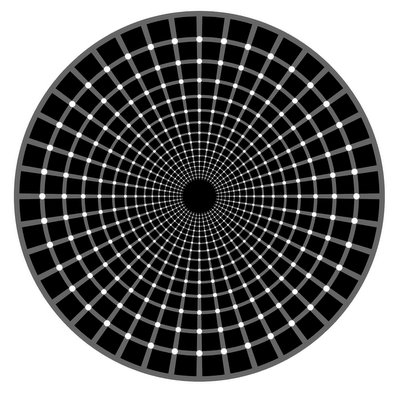
The black circle appears to expand while the outer gray circle appears to contract.
Tags:


This is a pretty neat optical illusion. You keep getting deeper and deeper into. When staring into the middle it appears as though the black hole is getting larger and larger, or that you are falling into it.


The Poggendorff Illusion is an optical illusion that involves the brain’s perception of the interaction between diagonal lines and horizontal and vertical edges.
It is named after Johann Poggendorff (1796-1877), a German physicist who first described it in 1860. In the image above, a straight black and red line is obscured by a grey rectangle. The blue line appears, instead of the red line, to be the same as the black one, which is clearly shown not to be the case in the second picture.
Stare at the center black dot. Do all of the black dots seem to bet bigger?
OR! Look at the center black dot again for 20 seconds.
Then look away from it quickly and you should see the same image just opposite. The Black dots will be white and the white bigger circles will be black, try it!
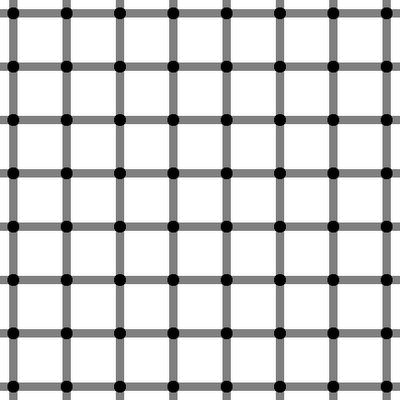
If you look around in the neighboring figure you will notice the appearance and disappearance of black dots at the crossings.Even though this figure looks similar to the Hermann-Grid, it is markedly more vivid. Furthermore, the effect is probably caused by different mechanisms than those causing the Hermann-Grid effect.1993: First demonstrated by JR Bergen at the ARVO, in a weaker variant1994: Re-discovered by Bernd Lingelbach’s wife Elke1995: Demonstrated at the Tübingen ECVP meeting (Schrauf M, Lingelbach B, Lingelbach E & Wist ER. The Hermann grid and the scintillation effect. Perception 24: suppl, 88–89)1997: Schrauf M, Lingelbach B & Wist E. The scintillating grid illusion. Vision Res 37:1033–1038, 2001: Invoked to explain Florida’s election problems (“Count the black dots, recount to confirm…” ;-)
Question: Do the streets or the squares influence the colour of the apparent disks?As you notice in the neighbouring figure, red streets leave the disks black. But if the squares are red (move mouse over figure), the disks acquire a reddish tint...